Does a house alarm reduce your home insurance?
Yes, a house alarm can reduce the cost of home insurance. It is one of the things the Competition...
read more
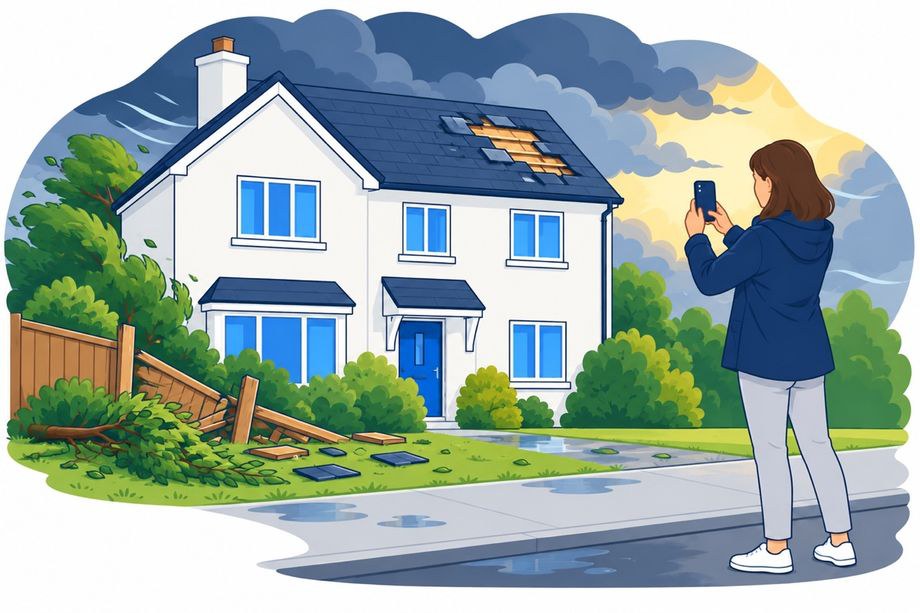
If a storm has damaged your home, four things to do first:
If you smell gas. Gas Networks Ireland asks you to call its 24-hour emergency line on 1800 20 50 50 immediately, no matter who your gas supplier is. Their guidance is to open windows and doors, not to smoke, vape or use a naked flame, and not to unplug or switch anything electrical on or off. Do not use a phone in the immediate area of the leak — call from outside or from a neighbour’s. If the smell persists they advise turning off the gas at the meter. If you cannot get through, dial 999 or 112.
Fallen wires. Never approach or handle one. ESB Networks says to assume electricity wires are always live. Their emergency number is 1800 372 999, 24 hours.
Water in your electrics. If water has reached sockets, wiring or the fuse board, keep clear and switch nothing on. Have the installation checked by a registered electrical contractor before it is used again. That is your wiring; the network outside your home is ESB Networks’ responsibility, on the same number.
Once the immediate dangers are dealt with, photograph the damage before you clear up. Wide shots showing the property, then closer shots of individual damage. If a fence, tree or slate has come from a neighbouring property, photograph that too.
Only take photographs from a safe position. Do not climb onto a roof, enter a damaged structure or go near fallen cables for a picture.
Keep damaged items rather than disposing of them where you can do so safely. Your insurer may want to see them.
The Competition and Consumer Protection Commission (CCPC) advises calling your insurer or broker as soon as you discover a problem, and notes that many have a free emergency helpline. Ask for a claim form and give brief details of what has happened.
Notifying your insurer is not the same as deciding to claim. Policies commonly require an incident to be reported within a set period whether or not you go on to claim, so reporting early keeps your options open. Check your own policy wording for what it asks of you.
Emergency measures are what stop the damage getting worse or keep people safe — covering a damaged roof, securing a broken window, making a structure safe. Work of that kind should not wait for an insurer, and it should not be attempted yourself either. Roof and structural work needs a suitably qualified professional with the right equipment. Your part is to keep everyone clear of the hazard while it is arranged.
Whether your insurer will reimburse you is a separate question from whether the work should happen. Check whether emergency-repair costs are covered as early as you reasonably can, and keep every receipt and photograph either way.
Permanent repairs are different. Get your insurer’s agreement before starting them, because once damage is repaired it cannot be inspected. You are asking for the go-ahead to begin, not waiting for the claim to be settled in full.
If your claim is significant, your insurer may appoint a loss adjuster to inspect the damage and assess the claim. The CCPC puts the distinction plainly: an assessor works for you, while a loss adjuster works for the insurance company.
You can hire your own assessor to negotiate on your behalf for a larger claim, but the CCPC notes that an assessor’s fees are not covered by your policy. Weigh the cost against the size of the claim.
Not every bit of storm damage is worth a claim. Two things to weigh:
Cover for storm damage depends on your policy, and the detail varies. Check your wording for:
Met Éireann issues yellow, orange and red warnings before severe weather. These are public safety warnings. A warning colour does not by itself determine whether damage is covered — the policy terms and the circumstances of the damage are what matter. Do not assume a red warning guarantees a payout, or that the absence of a warning prevents one.
If you are not sure whether something is covered, or what your policy asks of you after damage, talk to us before committing to permanent repairs. Call 0818 92 92 42, Monday to Friday, 9am to 5.30pm. Outside those hours, contact your insurer’s emergency assistance line if your policy provides one — the number is on your policy documents.
More on house insurance in Ireland and making a claim.
Sources: Gas Networks Ireland — what to do if you smell gas; ESB Networks — report a fallen wire; CCPC — making an insurance claim; Met Éireann — weather warnings. Cover always depends on the terms of the individual policy. Last reviewed 10 November 2026.


Yes, a house alarm can reduce the cost of home insurance. It is one of the things the Competition...
read more
The sum insured on a house insurance policy is the cost of rebuilding the house from the ground u...
read more
Comparing house insurance only works when every quote describes the same thing: the same rebuild...
read more